Thursday, April 28, 2011

Tutorial 8 - Week 9

Before beginning my journalism degree at UNSW, I did two years of a Bachelor in Forensic Science and Applied Chemistry at UTS, and I know all too well the importance of visualising science. The visualisation of science is both important for the understanding of scientific concepts by the lay person, but also for the application of the science by scientists. I remember in one lesson we were instructed to create all the measurements to assess how a speeding car crashed through a billboard. Without being able to visualise our scientific measurements, there is a good chance no one would have realised my mathematical skills were so off, I had measured the 'speeding' car to be practically stationary.

I know from first-hand experience, science is hard. Scientific concepts and scientific language, when delivered in a theoretical manner, are very difficult for the ordinary person to understand. The visualisation of scientific concepts, such as in the Information is Beautiful reading help the average Joe to really see what impact issues like climate change are having on the world. The visualisation allows people to understand scientific processes and develop ways in which they can assist or delay such a process. Through visualisation people can see the greater impact scientific events are having on a variety of levels; locally, nationally and globally, such as in the CO2 Now reading.

This video demonstrates how the visualisation of the sonic boom allows people to easily comprehend what a sonic boom is, and how it works, by seeing this concept visualised.


I think visualisation is a very important tool for encouraging people to take decisive action in regards to issues such as climate change. I have found that when you deliver facts in the form of bulk text and complicated equations, it goes in one ear and out the other. Whenever I try to explain a chemical process to someone, I usually find they don't understand it unless I draw out all the interactions between the atoms. This visualisation explains the concept of 'cap and trade', whilst this video, titled "Inspiring Action" visualises the destruction of the earth to encourage people to take action.

It is really important that messages are conveyed through the publishing of visualised scientific messages. The visualisation of scientific concepts gives people a new perspective about the issues and events that are happening around them.


Whilst I'm on the topic of visualised science and global warming, here are lots of polar bears visualising science and science-based activism.

Source: http://media.nj.com/njv_shenemans_sketchpad/photo/climate-changejpg-848943ae7786e958.jpg


Sunday, April 17, 2011

Tutorial 7 - Week 8

Visualisation is a very interesting aspect of publishing and it encapsulates a large variety of aspects. Modern society is very wrapped up in a 'visual culture'. People respond well to visual cues, and would seemingly rather look at picture or watch a movie than read text. Images are able to convey a greater message in a faster, more succinct way, and images (unlike language) are universal. Images do not always require an understanding of language and word devices to be understood. Even the simplest of images, such as the dashed line  can convey a variety of meanings and connotations, such as movement, direction, path, ephemeral material, etc. Images are able to provide the viewer with an understanding of physical data, data visualisation; like in the information aesthetics reading in which viewers can use the image to understand the value of 200 calories.

The combination of different images can create entirely new meanings, or (ironically) warp the perceived meanings of certain images:

Source: http://www.crainium.net/jdjArchives/StillMoreJuxtaposition.jpg

Source: http://www.crainium.net/jdjArchives/Juxtaposition.jpg

Source: https://blogger.googleusercontent.com/img/b/R29vZ2xl/AVvXsEgsPSYaOGkXd5g2g-xPtHAMrtUjFa07_OnKRlzQcf1yxykyjl3oTU2NA_XnkpMUOQSMdJdl-S3OR0_F8D3VdKL4P3YrHoH0AQoIVfr-MwDrUtaMTiOKoDN-w2nn5OFHswG1zZM44EPNWlQ/s1600/jux2.jpg

I think one of the aspects I found really interesting was the way in which visualisation can make the invisible visible. It is often simply taken for granted that certain information is known, even though we can't physically see it or touch it. It's almost scary to know that data is transferred around us without our knowledge. Just to link back to ANT; I was slightly confused by how technology could be interacting without the human component in ANT, however, the visualisation of technology has really demonstrated to me just how technology can interact with limited human involvement. Images such as the one below really highlight the way in which technology can function alone.


Source: http://www.richardbanks.com/wp-content/uploads/2009/03/image4.png 

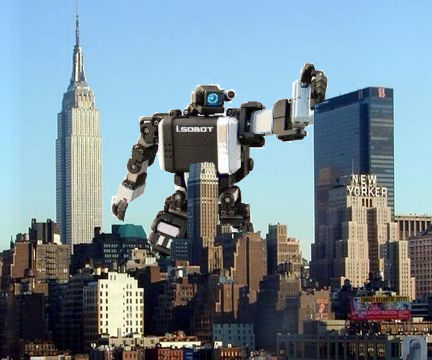
I just hope we don't find that this becomes our future:

Source: http://www.franksworkshop.com.au/Robots/isobot/isobot-city.jpg

Friday, April 8, 2011

Tutorial 6 - Week 7

Wikileaks; a shining example of transparent publishing or a risky social tool that endangers lives?

I've always felt that transparency in publishing is critical, especially when it involves the publication of government activities. There has been criticism over Wikileaks' policy on transparency with fears that it could put people's lives at risk as it names those involved in given activities, such as in the Afghan War Diaries. However, the activities of governments and those with authority (primarily in wars) results in multiple casualties on both sides. Are the actions of Wikileaks any different to those of governments?

Wikileaks really demonstrates the amount of power one is given when publishing, a power which higher authorities seem very unwilling to share. Wikileaks is providing the modern version of the effect the printing press had; the printing press allowed for the masses to be educated, and with knowledge came the all-important ability to question. Wikileaks has given the average person that same knowledge, and same ability to question and scrutinise the actions of authorities and organisations. It's quite interesting that what can bring down a government or corporation is not physical warfare (in which so much time, money and so many lives gets spent on) but rather, a simple act of publishing. Wikileaks has broken down the wall that separated the public from knowledge and information. However, as they say, ignorance is bliss. With knowledge and power comes responsibility - but for who? With Wikileaks publishing highly confidential (but still within the public right to know) documents, are the public now expected to take some sort of responsibility for the information they read and act? Or are the exposed organisations supposed to take responsibility, aware that the public now know about their dealings?

Wikileaks can also be considered an alternate media, or even the new media (as is my debate topic). When other news corporations are relying on Wikileaks and doing deals with Wikileaks about story publication, then I think it can be said that Wikieaks is the new media. I've also found that Wikileaks' process of researching, verifying and proving sources are more reliable and valid, unlike in traditional media who have often reported stories that have incorrect information, no evidence or are based on untruths, such as here, here and of course, our all time favourite, Kings Cross shooting here.

Rather unfortunately for Julian Assange, I feel his "radical" actions that contradict the status quo have meant that he has been treated like this:
Source:http://www.bonkersworld.net/wp-content/uploads/2010/08/2010.08.24_Julian_Assange.png

Saturday, April 2, 2011

Tutorial 5 - Week 6

Source: http://magicianbrianglow.com/images/attention.png


How does published material capture and maintain our attention? Who desires this attention and in what form? Who gets to be attentive, and how does this affect the way in which they relate and who they relate to?

Commons have begun to completely change the way in which we interact with published material, as well as changing the ficus and intentions of the audience. As Jay Walljasper argues in the Common Dreams blog, the development of a common place for information sharing has altered the way in which people think and has resulted in a shift in power. This is a shift that has become very pronounced recently with the influx of citizen journalists and bloggers who audiences are turning to for information instead of traditional sources. This does raise questions about the validity of the information passing through these commons, however it has been shown that Wikipedia is more accurate than Encyclopaedia Britannica. It would seem that commons provide a greater range of perspectives, include a vaster audience and thus enriches the information being shared as it goes through a greater number of checks, views and expertise. The use of commons eliminates the sort of social hierarchy that existed before commons, as now everyone can give their perspective, rather than a select group of individuals informing a mass population.

The use of commons has changed the format which audiences use. No longer are audiences willing to just sit and read or watch, audiences now want to interact. Audiences also want to personalise the information they get from common information pools, causing websites to provide users with 'personal recommendations' for music or video tastes, personalised weather updates, personalised greetings upon opening a website etc. As highlighted in the "technics of attention" reading, audiences have been divided up depending on their level of technical-literacy. My parents, for example, find it much more difficult to interact with and pay attention to technologically advanced mediums, and often require my brother and I to decipher the 'text speak' or show them how to operate a video online. Their attention, thus, is focused on commons that require limited technological skill and basic levels of interactivity, whereas my brother and I focus our attention on highly-interactive sites where we can have our own input and connect with a greater number of people. I wanted to include this comic strip which shows how to great authors perceived the future world and the concerns they had about the influence of technology. It is really interesting to see how they believed audiences would react and what would entice audiences to access information. The comic is a bit hard to read, a larger copy of it is available at Juxtapoz Magazine.

Source: http://www.juxtapoz.com/Current/huxley-vs-orwell-in-graphic-form

The use of commons however does lend itself to the issue of piracy. Ever since the development of a common, the debate about whether the sharing of information in this common is legal. Is a common a vehicle for the illegal spreading of copyrighted content? Or are people enacting their freedom to use and share what they want? As long as those who are sharing the material are not making money from it, does that make it ok? Personally, I feel that if a source is shared online, it is no different to sharing a book or cd in person.